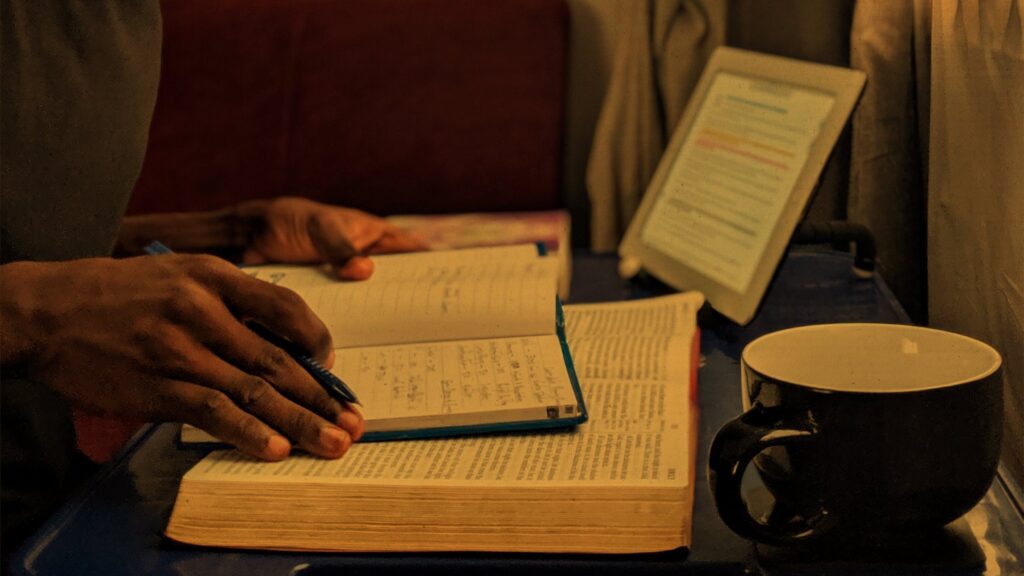
Psalm 4 opens with David remembering a rescue, and he describes it in two words that are, quite literally, opposite shapes.
The trouble he was in is tsar (צַר) — usually translated “distress.” But the word is spatial before it is emotional. Its root is narrowness. A tsar (צַר) is a tight place, the kind of cramped space where there is no room to pass. One Hebrew dictionary describes the feeling it carries: as if one were confined to a narrow, cramped space from which there is no escape.
The rescue is the mirror image. David says hirchavta li (הִרְחַ֣בְתָּ לִּ֑י) — most Bibles render it “you gave me relief,” which is accurate but flattens the meaning of the Hebrew. The verb means to make wide, to enlarge, to open out. It’s the word Isaac uses when he finally digs a well no one fights him over: “now YHWH has made room for us” (Gen 26:22). So the line isn’t abstract at all. It’s a picture of movement from one kind of space to another: when I was jammed into the narrow place, you opened the walls and set me in the wide field.
Hebrew poetry thinks in space this way more often than translation lets through. Salvation is room to breathe; trouble is a room with no door. David isn’t only saying God helped him. He’s saying he could feel the walls move back.
We use cookies to improve your experience, personalize content, and analyze traffic. By continuing to use our site, you accept our use of cookies. For more information, please review our Privacy Policy.